If you've searched anything about Florida roof insurance rules in the last few months, you've probably read that a new law took effect July 1, 2026 expanding protection for older roofs. Several insurance-agency blogs describe it in detail. Some name the bill number. It sounds settled.
It isn't. Senate Bill 808 and its House companion, HB 815, would have done exactly what those articles describe. They also died in the Senate Rules Committee on March 13, 2026, and never became law. You can check this yourself on the Florida Senate's own bill page, which shows no action past committee referral.
For most of Florida, that's a footnote. For Palmer Ranch, it's the difference between a smooth closing and a financing scramble, because a large share of the neighborhood's housing stock is sitting at exactly the roof age where this would have mattered.
The Law That Didn't Make It
Here's the confusion in one table.
What's being repeated online | What's actually true as of August 2026 |
|---|---|
A new 2026 law expands roof-age protection to all residential property policies | SB 808 / HB 815 died in committee March 13, 2026. Never enacted. |
Roof consultants and observers are now authorized inspectors | Still limited to earlier-law categories: home inspectors, engineers, and architects; licensed roofing contractors were added by HB 1611 in 2024 |
Protection applies to any residential structure, including rentals and investor holdings | The 2022 rule (Florida Statute 627.7011) protects standard owner-occupied homeowner's policies, not landlord or investor forms |
The law that actually governs your roof right now is the one passed in 2022 and refined in 2023 and 2024. It says an insurer can't refuse to issue or renew a homeowner's policy solely because a roof is under 15 years old. Once a roof crosses 15, the insurer can require an inspection, but if a licensed inspector certifies at least five years of remaining useful life, the insurer still can't decline coverage on age alone. One real addition did pass: House Bill 1611, effective July 2024, added licensed roofing contractors to the list of professionals who can perform that certification, so you no longer need to hire an engineer just to prove a roof still has life left.
That's the actual toolkit. Nothing broader came this July.
Do the Math on Your Own Street
Palmer Ranch's oldest sections date to the mid-1980s, but the bulk of the community, more than thirty neighborhoods spread across roughly 10,000 acres, built out between the mid-1990s and 2010. Do the arithmetic against today's date and a home finished in 1995 is 31 years old. One finished in 2010 is 16. That entire span sits at or past the 15-year threshold where an inspection becomes routine, and a meaningful share of it is past 20, the age at which Mesa Insurance says most carriers require a full four-point inspection covering roof, electrical, plumbing, and HVAC.
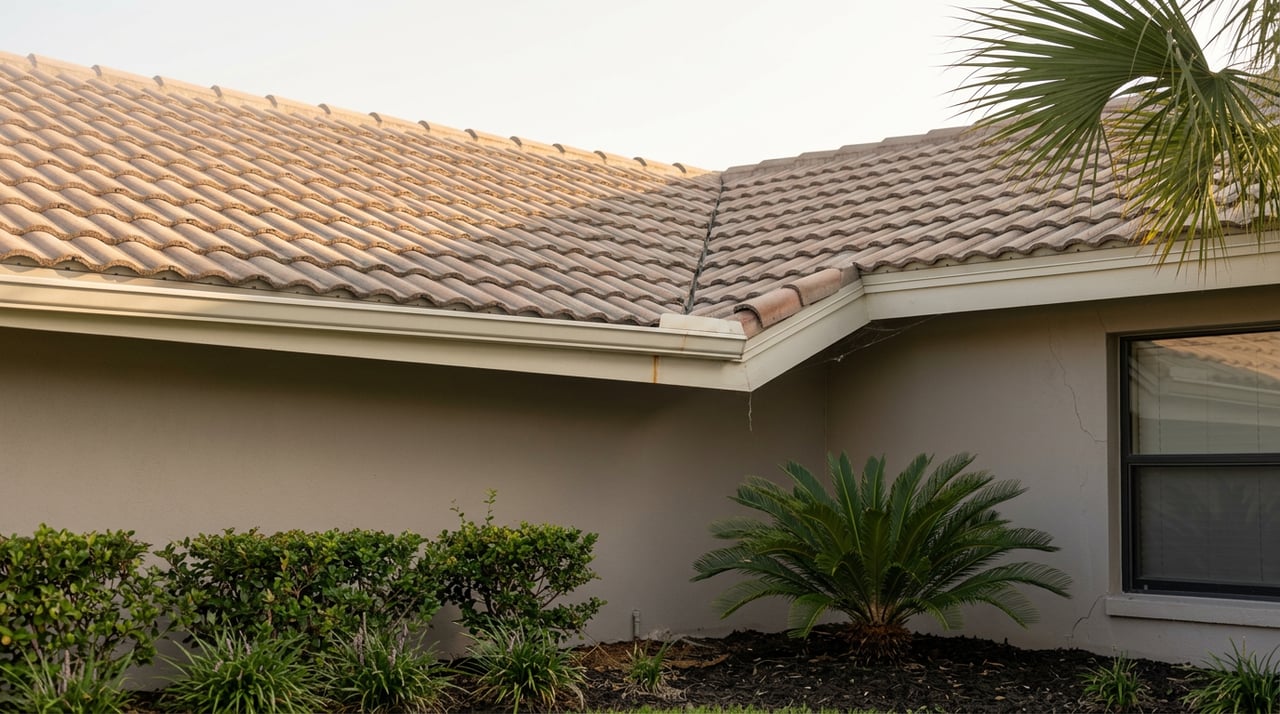
Local roofing contractors who work these streets describe Palmer Ranch and neighboring Turtle Rock as tile communities almost without exception, and that tile is now hitting a specific failure point. Concrete tile itself can last 25 to 40 years. The underlayment beneath it, the membrane that actually keeps water out, has a shorter life in Gulf Coast heat and humidity. A roof can look immaculate from the driveway, tile intact, no visible cracks, and still be the reason a four-point inspection comes back flagged.
A tile roof that looks perfect and a tile roof that passes underwriting are two different questions. The tile is decorative armor. The underlayment is the actual waterproofing, and it ages on its own clock.
That distinction matters most in communities like Deer Creek, Prestancia, Stoneybrook, and Silver Oak, where original roofs from the community's early build-out years are now old enough to draw underwriter attention even though nothing looks wrong from the street.
Two More Systems Quietly Aging Next Door
Roofs aren't the only clock running on these same blocks.
Homes from Palmer Ranch's 1980s and 1990s construction years can still carry polybutylene supply piping, the gray plastic pipe used industry-wide before it became known for failing at crimped fittings. Insurers increasingly flag it during a four-point inspection, and some require a full repipe as a condition of coverage rather than a discount for having it. If you're selling a home from that era, it's worth knowing before a buyer's inspector finds it first.
Most Palmer Ranch villages also irrigate with reclaimed water, which is easier on the water bill but harder on hose bibs, backflow assemblies, and irrigation valves, and it's what causes the mineral staining many owners notice on pavers and screens. It's cosmetic, not an insurance issue, but it's the kind of detail a buyer notices on a walkthrough and asks about, and having an answer ready beats guessing.
And if a roof does need replacing before closing, build in real time for it. Coastline Roofing says most Palmer Ranch communities require HOA architectural review before roofing work can begin, which adds a scheduling step that a mortgage contingency deadline doesn't wait for.
What Actually Protects You, and What Doesn't
If you're under contract on a Palmer Ranch home right now, or about to list one, here's what's worth doing before the roof becomes a surprise late in the transaction.
- Confirm the roof's actual age, not its appearance. Permit records or the original builder's paperwork settle this faster than a visual walk.
- If the roof is 15 years or older, get a certification now, not after a carrier flags it. A licensed roofing contractor can perform this under HB 1611, and it's typically a few hundred dollars against the alternative of a denied policy.
- Ask whether the policy in question is a standard owner-occupied homeowner's form. The 2022 protection was written for that category. If you're buying as an investment or rental property, confirm with your agent how the underwriting differs.
- Get a binding insurance quote before your inspection and financing contingencies expire, not after. A quote that arrives after those windows close leaves you renegotiating from a weaker position.
- If a roof replacement is part of the deal, ask about HOA architectural review timing as early as the offer stage, not the week before closing.
The Number Nobody Puts Next to the Roof
There's a piece of good news buried in all this, and it's worth putting the roof-age issue in context rather than treating it as a crisis. Florida's property insurance market has been genuinely improving. Citizens Property Insurance, the state's insurer of last resort, saw its policy count fall to roughly 294,000 by May 2026, down from a peak near 1.4 million, as private carriers regained appetite for Florida risk. Citizens cut rates by about 8.8 percent on multiperil policies and 5.5 percent on wind-only coverage effective July 1, 2026, applied to new policies and at renewal for existing ones.
None of that erases the roof-age math for a specific 1998 tile roof in Prestancia. But it does mean a certified, documented roof is landing in a market with more competition and more willing carriers than it would have two years ago.
One more number worth knowing if you're weighing Palmer Ranch against newer master-planned communities: Palmer Ranch doesn't carry Community Development District fees, the additional assessment that funds infrastructure in many newer developments, including parts of Lakewood Ranch. That's a real difference in annual carrying cost, and it's worth setting next to whatever the insurance conversation turns up before deciding what a given Palmer Ranch home actually costs to own.
A Few Questions Worth Settling Early
Does every tile roof in Palmer Ranch need to be replaced at 15 years? No. The law doesn't set a hard replacement age. A tile roof with sound underlayment can pass certification well past 15 years. The point is that age alone triggers scrutiny, and only an actual inspection settles the question either way.
Is flood insurance required for Palmer Ranch homes? Much of Palmer Ranch sits in Zone X, where lenders typically don't require flood coverage, though flood zones vary by elevation and drainage even within the same community, and it's worth confirming for the specific address rather than assuming based on the neighborhood name.
If I'm selling, should I get a roof certification before listing? It's a reasonable step if the roof is 15 years or older. It gives buyers a documented answer instead of a guess, and it can prevent a financing contingency from stalling over a roof question that a few hundred dollars could have settled in advance.
If you're weighing what an older Palmer Ranch home actually costs to insure and own, or you're getting ready to sell one and want to know what a buyer's lender is going to ask about the roof before they do, Susan L. Phelps has spent years walking Palmer Ranch buyers and sellers through exactly this kind of detail. Search Homes to see what's currently available across Palmer Ranch's neighborhoods, or reach out directly to talk through a specific property before you list or write an offer.
This article is general information, not legal, tax or financial advice. Consult a qualified professional about your situation.