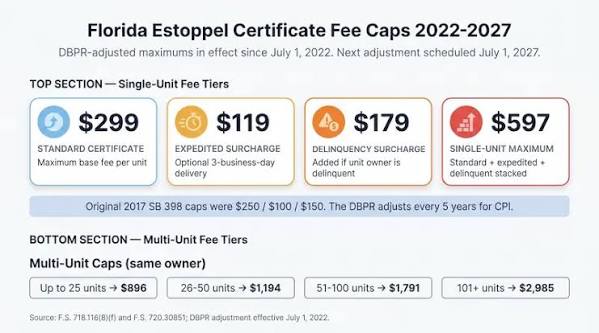
Florida law lets an owner, a lender or their designee request an estoppel certificate from a homeowners' association, a document that includes association amounts owed. On its website, the Palmer Ranch Master Property Owners Association lists an email address and a fax number for these requests. Under them is one line: "Fee increase to $175 on 11/01/26."
That fee change takes effect this Sunday, November 1. The certificate itself matters more than the fee. In Palmer Ranch, a property can belong to more than one association. Buyers comparing neighborhoods here tend to focus on the master assessment, which is small and has stayed put for years. The costs that actually separate one Palmer Ranch address from another sit further down the stack.
What the estoppel certificate has to show
Florida's homeowners' association statute, Section 720.30851, spells out what an estoppel certificate must contain. It covers the regular assessment and how often it's paid, an itemized list of association amounts owed, any capital contribution or transfer fee, and any open rule violation. Item 10 on the statutory form is the one that matters most in a master-planned community:
Provide a list of, and contact information for, all other associations of which the parcel is a member.
PRMA's new $175 fee covers the master association's certificate only.
For a buyer, it's useful to consider the layers of association costs while choosing between neighborhoods.
Four budgets at the same rate
The master association's own budgets explain why its number makes such an easy comparison point. It hasn't moved.
Budget year | Rate per assessable unit value | Projected unit values | Assessment revenue | Prior Period Surplus line |
|---|---|---|---|---|
2024 | $175 | 13,192 | $2,308,600 | $600,000 |
2025 | $175 | 13,521 | $2,366,175 | $750,000 |
2026 | $175 | 13,900 | $2,432,500 | $775,000 |
2027 | $175 | 14,132 | $2,473,100 | $775,000 |
Two things keep the rate flat, and the table shows both of them.
The first is growth. From the 2024 budget to the 2027 budget, the number of projected assessable unit values rose by 940, about 7 percent. Each new value pays the same $175, so assessment revenue climbed by $164,500 while nobody's rate changed. That's simple arithmetic for a community that is still adding homes.
The second is the surplus line. Every one of these four approved budgets counts on a "Prior Period Surplus" as income, and that line grew from $600,000 to $775,000. In the 2027 budget, the $775,000 is about 22 percent of the $3,522,461 in total income. At its September 24, 2026 meeting, the board approved the 2027 budget and also voted to carry any 2026 excess revenue forward to offset 2027 expenses. The budgets show surplus planned in every year. They don't show how much of it was actually realized. Either way, the flat rate rests on a mix of new members and money carried forward, and both depend on circumstances that change.
One caution on the math. The budget bills per "assessable unit value," and the community's Declaration of Protective Covenants decides how many unit values a given property carries. Don't assume one home equals one unit value.
What $175 per unit value pays for
The master association describes its job as enforcing the covenants, monitoring the development's governmental requirements, and maintaining common-area landscaping, including public road and drainage rights-of-way. The 2027 budget shows how that splits out:
- Grounds dominate. Maintenance totals $2,045,376. That includes $473,292 for turf maintenance, $392,700 for ornamental refurbishment, $329,076 for ornamental maintenance and $262,464 for fertilization and pest control.
- Water is a real line item. Aquatic weed control is budgeted at $238,656, and reclaimed water at $83,820.
- People and coverage. Total employee costs are $525,600 and the insurance accrual is $165,620.
- Help from the county. Sarasota County maintenance payments add $242,561 to income.
The reserve schedule is the more telling page because it shows what's aging. Two entry walls on Beneva Road, at Palmer Ranch Parkway and at Sarasota Square Boulevard, were built in 1986 and list a first replacement year of 2028. Their estimated replacement costs are $156,375 and $31,950. Streetlight resurfacing on McIntosh Road is carried at $302,500 with a 2037 date. Five stormwater and groundwork restoration areas, lettered C, D, F, G and H, are each reserved at $50,000. In April 2026 the board also approved additional payments for the Honore Avenue Phase V and Bay Street Extension work, along with a $33,089.50 turf refurbishment on McIntosh Road. At the September meeting, the board approved the final report of its Palmer Ranch Stormwater Management Ad Hoc Committee.
Almost everything on that list is shared scenery: medians, entry features and streetlights along the roads every Palmer Ranch resident drives. The master budget doesn't include your neighborhood's gate, its pool, its private streets or its building insurance.
Where the neighborhood layer takes over
Turtle Rock's community association describes the next layer down. Owners there are members, pay dues quarterly, and fund the common areas, management and gate staff, insurance, utilities, irrigation water and reserves. The association also says part of its dues goes up to the Palmer Ranch Master Association.
Then there's a third layer. Turtle Rock lists extra section-level fees for owners in Savannah and Somerset. So a home in one of those sections pays into three layers: the master, the neighborhood and the section, even though the master share reaches PRMA through Turtle Rock's dues.
Every neighborhood within Palmer Ranch sets up this layer differently, and that's where two homes at similar list prices can end up far apart in yearly cost. Club memberships add another variable to check one community at a time. TPC Prestancia, for example, offers separately classified golf and sports memberships on its official membership page.
Who decides the master number
The master board has fifteen elected trustees: ten from residential members, three from commercial-industrial members and two from recreational members. The Declarant has used its option to appoint a sixteenth. Homeowners don't vote at master meetings directly. Each sub-association's president, or an officer that president designates, serves as the community or tract representative who speaks and votes for that neighborhood's members.
So your voice on the master budget passes through your neighborhood association. When you're comparing two Palmer Ranch neighborhoods, it's worth asking how engaged each one's representative is at those meetings.
Questions buyers ask about Palmer Ranch association costs
Is the master assessment going up in 2027? No. The approved 2027 budget keeps the rate at $175 per assessable unit value, the same rate used in the 2024, 2025 and 2026 budgets.
Who pays the estoppel fee? That depends on the contract and local custom, so ask your closing agent. PRMA's own fee becomes $175 for requests on or after November 1, 2026.
This post is general information, not legal or financial advice. Please confirm the documents and fees for your own property with a Florida real estate attorney or your closing agent.
If you're weighing two Palmer Ranch neighborhoods and want to see the master, neighborhood and section costs side by side before you write an offer, Susan Phelps can help you request the governing documents early and go through each layer with you.